


A research team from has published a new study in Plant Physiology revealing a key molecular mechanism that regulates flowering time in temperate maize.
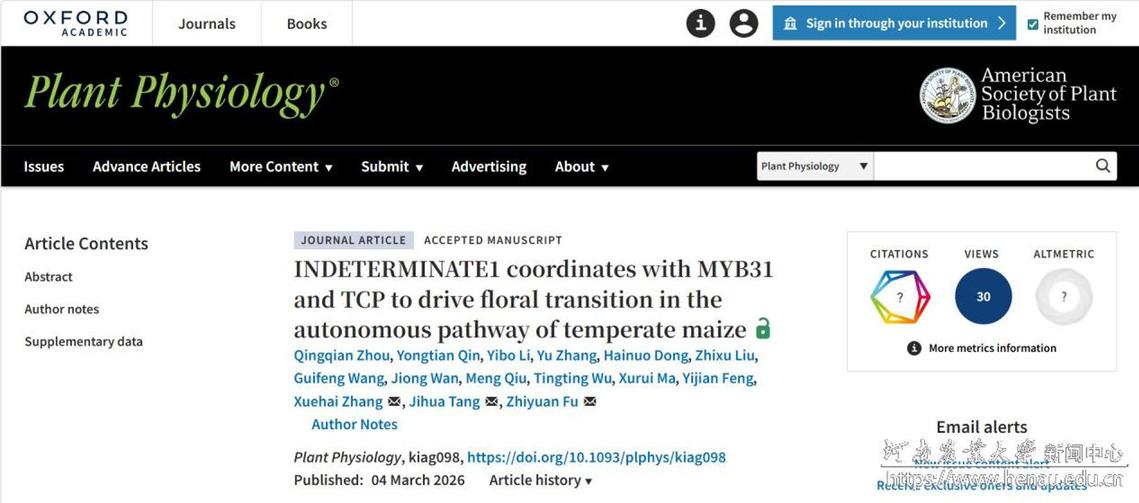
The paper, titled “INDETERMINATE1 coordinates with MYB31 and TCP to drive floral transition in the autonomous pathway of temperate maize,” was completed by the team of Prof. Tang Jihua and Prof. Fu Zhiyuan.
The study shows for the first time that INDETERMINATE1 (ID1) regulates maize flowering through a dual-pathway model. The researchers found that ID1 works together with MYB31 and TCP proteins to activate key flowering genes, while also acting through the SBP20–ZCN8 pathway to promote floral transition.
The findings help explain a long-standing question in maize flowering regulation and provide new theoretical support and genetic resources for improving flowering time and yield in crops.
The study was co-authored by Prof. Zhou Qingqian, Qin Yongtian, and Li Yibo. Prof. Fu Zhiyuan, Prof. Tang Jihua, and Associate Prof. Zhang Xuehai are the corresponding authors.
The research was supported by the National Natural Science Foundation of China and other provincial research programs.
DOI: 10.1093/plphys/kiag098


